Update — August 20, 2026
No Water, an Overloaded PJM Grid at 290 MW, and The Little Land Development Plan That Couldn’t
Through a Right-to-Know request, Ginny Kerslake of Food & Water Watch, an invaluable ally to communities across the region, discovered that Sentinel Greenfig (SGF) does not have the AQUA will-serve letter for the approximately 4.2 million gallons of water per day required by its only approved plan. Kerslake also obtained emails showing Township Solicitor Bernadette Kearney requesting the service letter from SGF’s attorney and receiving a draft, unsigned document in return.
That discovery puts SGF’s latest proposed changes in a very different light. Removing the basement, moving generators outside, and putting air chillers on the roof aren't simply an “upgrade.” They appear to be the only way SGF can build the project. SGF is attempting to make these changes as “field changes,” a process intended for minor changes made during construction. Residents demanded that the East Whiteland Board reject that approach and follow its own code requiring resubmission of the land development plan.
Meanwhile, active EWU member and resident Julie Ferris discovered that SGF does not have Pennsylvania Public Utility Commission approval for 290 MW. When PECO requested PJM perform its “Do No Harm” analysis, the proposed 290 MW load caused overloads on the grid. SGF currently has approval for only 150 MW, and PECO has not filed an additional application with the PUC for the 290 MW, despite that capacity being advertised as immediately available.
Ferris also uncovered records detailing the Phase 1 and Phase 2 buildout of the substation work for SGF discussed in meetings between PECO and PJM. Phase 2 supports the 290 MW load that has not been approved by the PUC. Yet on Wednesday, August 19, control houses consistent with the Phase 2 scope were delivered to the Superfund site.
Schools, businesses, and residents, including Ferris, have filed Petitions for Rescission with the PUC challenging the original approval for the 150 MW Phase 1 infrastructure because PECO, despite requiring an easement across the Superfund site, told the Commission there were “no environmental matters.”
Township residents were fired up and showed out at Wednesday’s Board of Supervisors meeting, an anomaly for a summer meeting, with residents joining online from as far away as Chile. Residents urged the Board to hold the line and revoke the building permits as the laundry list of issues surrounding the project continues to grow.
And breaking the stigma of politicians, Senator Katie Muth, who may have a legitimate claim to Roy Kent’s “he’s here, he’s there, he’s every *#@$% where” anthem as she runs Township to Township supporting residents fighting data centers, managed to show up again, educate the crowd, and do what no other representative does: stand up for her constituents. East Whiteland United has reached out to representatives from both parties, at both the state and federal levels, and has received no response or engagement from any elected representative other than Senator Muth. With the involvement of the EPA and other state and federal agencies, this matter extends well beyond the traditional boundaries of municipal law and local government.
Board members Steve Lambert and Clinton Smith engaged with residents and genuinely listened throughout the meeting, while Board Member Peter Fixler and Solicitor Bernadette Kearney rarely looked up from their computers, visibly frustrating many residents in the crowd. Regardless, the Board had few answers, including to the most important question repeatedly asked that night: “What plan is SGF currently building?”
The question went unanswered. And it matters. SGF has an approved plan, is seeking significant changes to that plan, and is actively performing work onsite. So which plan are they building? Residents contend that allowing construction to continue without an answer conflicts directly with the Township’s own code and executed agreements.
Many residents left deeply unsettled and alarmed by what they perceived as a lack of knowledge about missing documentation, the work currently underway, and adherence to the Township’s own code. After watching neighboring townships demonstrate command of the issues and stand alongside their residents, the meeting concluded with many East Whiteland residents angry, perplexed, and questioning why they are not seeing the same from their own Township. Residents are also increasingly skeptical of assurances that adequate diligence is being performed when something as basic as reading an attachment that confirmed whether a required document had actually been signed proved to be too big a hurdle for the Township.
Meanwhile, communications with the EPA provided little comfort to residents. Emails revealed that EPA staff were unaware of the 20-foot basement excavation included in SGF’s currently approved plan. FOIA records related to the project’s Soil and Health & Safety Plans also show EPA staff specifically calling for soil testing in an area where VOCs had been identified “ahead of excavation.” That testing did not occur ahead of excavation and was not reflected in the Soil and Health & Safety Plans posted on East Whiteland’s website.
Yet soil disturbance and other activity are currently occurring onsite.
Update — July 20, 2026
-
EPA Contradicts Itself. East Whiteland Township released a document containing what appear to be EPA's own comments. Several of those comments directly contradict EPA's own 2024 Third Five-Year Review. Most notably, EPA is now citing soil as meeting the 2008 cleanup standards, backpedaling from the Third Five-Year Review's own finding that those standards were not protective.1,2 There is no evidence of any soil sampling completed more recently than roughly fifteen years ago.3
-
EPA Confirms: “Ready for Reuse” Status Still Revoked. SWRAU was revoked in September 2024.4 EPA's new Q&A doesn't reinstate it, it only says the designation isn't legally required for construction to continue.5 Revoked is revoked.
-
The Basement Is Still Unaddressed. EPA's Q&A states plainly that it does not recommend, propose, or approve specific redevelopment plans.6 That includes the basement written into the only currently approved plan. EPA has not approved it, calling into question Green Fig/Sentinel's own past claim that the basement was “fully approved by EPA.” Meanwhile, the Board of Supervisors is trying to push through a complete overhaul of that same plan, replacing the basement's cooling towers with a rooftop air-chiller system through a “Field Change.”7 The reversal raises an obvious question: what is driving it, if not concern about excavating deep into contaminated soil.
-
MW-22 Has Been Sealed, As Confirmed in the Documents. A monitoring well with the highest contamination on the site, and the *only monitoring well* with a trendable VOC dataset, has been sealed so Greenfig/Sentinel can build a data center building on top of it. 8,9 EPA has provided no scientific plan for how it intends to preserve that trend data going forward, despite repeated public requests.
-
Ruling Out What It Didn't Measure for Groundwater. The EPA claims groundwater impact "is not anticipated," yet its own findings admit the "vertical and lateral extent" of groundwater contamination remains undetermined, leaving residents to ask how one rules out what one hasn't measured. Is ignorance bliss, or lethal?
-
The EHASP Runs on Outdated Numbers. The developer's own Environmental Health and Safety Plan builds its entire dust-safety math on the 2006 ROD's contaminant limits, not EPA's current standards. For lithium, EPA's own Regional Screening Level has dropped 6.5 times since then, from 260 µg/L to 40 µg/L, but the plan's single sitewide dust action level still assumes the old, looser number.14 Nobody has redone that math against the standard EPA actually uses today.
The Paper Trail Behind EPA's "Much Lower" Claim, and the Math Behind the Dust Plan
EPA's 2024 Third Five-Year Review found the site's soil cleanup goals are not protective, citing a non-cancer hazard index of 30 for a child resident and 2.1 for a composite worker, both above the acceptable limit of 1.1 In July 2026, EPA told the Township it had since evaluated “post-excavation confirmation soil sample data” and found concentrations “much lower” than those same goals, and therefore protective.2
The developer's Soil Management Plan and Environmental Health and Safety Plan, both dated July 10, 2026, claim the site has been remediated three separate times:
- Claim #1 (SMP, Introduction, p. 1): “...part of the...Foote Mineral Company Superfund Site...for which extensive soil remediation has been completed.”12
- Claim #2 (SMP, Section 4.3.4, Vapor and Odor Controls): “Organic vapors are not anticipated during earthwork since the soil at the Site has been remediated.”12
- Claim #3 (EHASP, Section 2.4, Qualifications): “Soils at the Site have been previously remediated.”13
The only soil data in either document is the confirmatory sampling from the original excavation, approved by EPA in a letter dated September 28, 2010, nearly fifteen years ago.3
EPA's 2024 finding was about whether the cleanup goals themselves are protective going forward. Fifteen-year-old sampling showing those areas met the old goals at the time doesn't answer that. Either EPA is describing that old data in a misleading way, or it has newer soil data it hasn't shown anyone. We're demanding the exact report title, date, and sampling event ID in writing.
The dust safety math has the same problem.
The developer's own Environmental Health and Safety Plan builds its entire dust safety calculation on the 2006 ROD's contaminant limits, not EPA's current standards. For lithium, EPA's own screening level has dropped 6.5 times since then, from 260 µg/L to 40 µg/L, but the plan's dust safety math still runs on the old, looser number.14 Nobody has redone that math against the standard EPA actually uses today.
On top of that, the calculation assumes every scoop of dirt sits right at the cleanup limit, never above it. We already have documented spots on this site that blow past those limits: lithium at MW-22 running 325 to 555 times acceptable groundwater levels, and hexavalent chromium tested at 169 mg/kg against a 20.5 mg/kg standard.15 The whole calculation only works if the dirt matches the target exactly, and their own numbers say it doesn't always.
Looking at their own table in the EHASP, manganese stands out. Manganese is the exact contaminant EPA's 2024 review pointed to as the main reason the site failed its safety check.16 Hexavalent chromium isn't far behind on that same list. Chromium is a known human carcinogen, and unlike the other chemicals here, health agencies say there's no truly safe amount to breathe at all. Their table doesn't treat it any differently than the others.
Most importantly, none of this is actually being measured. There are three dust monitors planned for the site, but they measure total dust mass in the air, not what's inside that dust.17 If a piece of equipment digs into a small pocket of contaminated soil, something their own report admits exists on this site, none of those monitors can catch it. It would just look like ordinary dust.
Put it all together, and this is a site where the last soil test was roughly fifteen years ago, built around a safety number already known to be outdated for at least one major contaminant, while the public is being told the soil is “remediated.” By the developer's own report, that word doesn't mean what most people would assume it means.
Background — Workers Started
On July 2, Green Fig/Sentinel were instructed to cease operations after work began on site without the required permits.10
Workers were seen on site installing fence posts on the north side of the property without wearing any protective equipment.
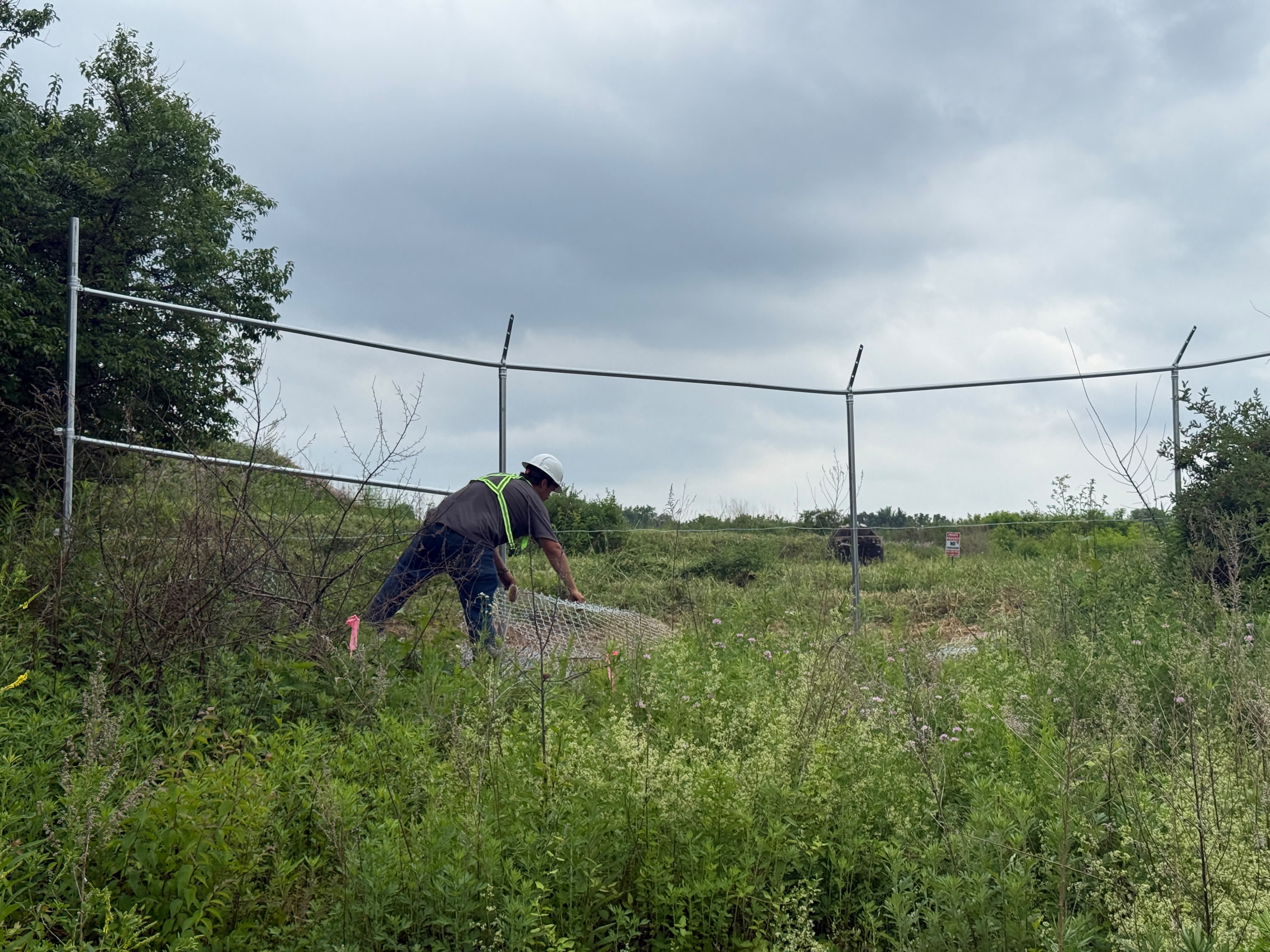
A worker installs fencing at the site without visible personal protective equipment beyond a hard hat.
State Involvement
Sentinel Green Fig has publicly posted signage at the site noting that its project has received financial assistance from the Commonwealth of Pennsylvania under Governor Josh Shapiro.11
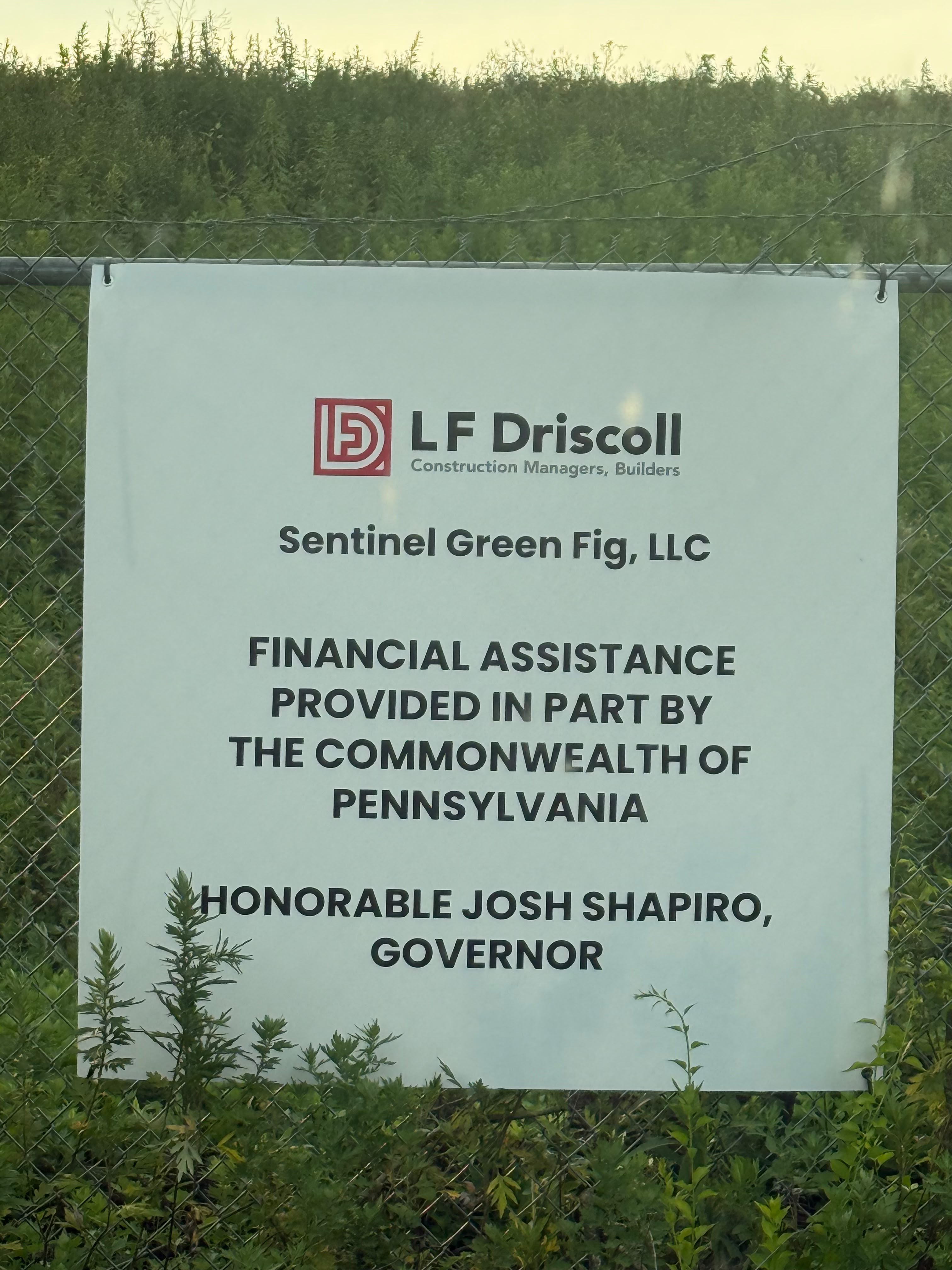
If you have views on state tax dollars being used for this project, you can contact Governor Shapiro's office directly.
Sources & further reading:
- EPA Third Five-Year Review (Sept. 2024), Appendix J, Tables J-3–J-5.
- EPA Responses to Questions for East Whiteland Township Meeting (on file), Q8.
- Soil Management Plan, Foote Mineral Co. Superfund Site, July 10, 2026, p. 11; 2011 Remedial Action Report for the Soils, Waste Materials and Debris Consolidation and Capping of the North and South Quarry.
- EPA Form 9100-4, SWRAU designation revocation, Sept. 16, 2024.
- EPA Responses to Questions for East Whiteland Township Meeting (on file), Q3.
- EPA Responses to Questions for East Whiteland Township Meeting (on file), Q11.
- East Whiteland Board of Supervisors field change authorization; developer submissions to the Planning Commission, February and March 2026.
- EPA Responses to Questions for East Whiteland Township Meeting (on file), Q10.
- EPA Third Five-Year Review (Sept. 2024), Table D-3, VOC results; MW-22 sampling history and discussion.
- "East Whiteland directs data center developer to stop work on Superfund site," Philadelphia Inquirer, July 2, 2026.
- Site photograph, on file, of posted project signage.
- Soil Management Plan, Foote Mineral Co. Superfund Site, July 10, 2026, p. 1 and Section 4.3.4.
- Environmental Health and Safety Plan (EHASP), Foote Mineral Co. Superfund Site, July 10, 2026, Section 2.4.
- EPA Third Five-Year Review (Sept. 2024), Appendix I, Table I-1; EPA Regional Screening Levels, May 2024 update.
- EPA Third Five-Year Review (Sept. 2024), Table D-2 (lithium groundwater results); Table J-3 (hexavalent chromium soil results).
- EPA Third Five-Year Review (Sept. 2024), Appendix J risk discussion; Soil Management Plan, July 10, 2026, p. 12 (quoting the Third Five-Year Review on manganese as a major driver of excess risk).
- Environmental Health and Safety Plan (EHASP), July 10, 2026, Section 3.4.1, Dust Monitoring.